понедельник, 1 апреля 2013 г.

Rendering 6


The headline of the article is Shakespeare scholars unite to see off claims of the 'Bard deniers'.
The article is from а newspaper under the nameplate the Guardian.
The publication date of the article is March, 30.
 The article is written by Dalya Alberge.
The basic subject matter of the script is discussions on the matter of Shakespeare’s authorship.
The author starts by telling the reader that a group of 22 of the world's leading Shakespeare scholars have come together to produce a book that details what they consider to be definitive evidence that the Bard really did write his own plays.Three eminent experts on Bacon, Oxford and Marlowe are among the Shakespeareans who demonstrate in a series of essays precisely why only Shakespeare could have written his plays and poems, apart from his collaborations. Cambridge University Press will publish Shakespeare Beyond Doubt: Evidence, Argument, Controversy on 18 April, days before the Shakespeare birthday celebrations in Stratford-upon-Avon on 20-21 April. The publication – which they say will be scholarly, but accessible for general readers – is co-edited by Paul Edmondson and Stanley Wells, noted scholars from the Shakespeare Birthplace Trust, the academic charity. There are many opinions and views on the publication of this book as it will contain different points of view in one volume. Later the author gives the reader some information about Shakespeare’s personality by different critics and Shakespeare’s followers.
I found the article interesting and important for reading as it’s an actual topic today. We don’t know exactly who Shakespeare was and if he was a real person or just it was anonym for us! But I think nobody assert precisely who he was. It will remain an everlasting secret for us!

Individual Reading Chapters 17 - 30

Having just moved to Paris, the narrator pays a visit to the studio of his old friend Dirk Strove. Strove’s pictures are not masterpieces but just funny paintings. His wife Blanche tells how good they are. To change the subject of their conversation, the main character asks Dirk if he knows Charles Strickland. Dirk is surprised to hear that Crabbe also knows this man and says that Strickland is certainly an artistic genius. Then the narrator and Dirk meet Charles at the same restaurant as some time Crabbe met him 5 years ago. Mr Strickland looks not so well, he continues to make paintings but he doesn't try to sell them to get long shillings and food, and the comfortable conditions for living. After their meeting Charles disappears and Dirk starts to worry about him in spie of the fact that Strickland doesn't want to hear anything from him. Meanwhile, the main character and Strove find him very ill in his little room. Strove makes a decision on taking Charles to his studio to carry about him but Blanche can't hear it but then she agrees. When  Strickland becomes better, Dirk offers him to paint in his workshop together but Charles, in his turn, doesn't wish to share the room with anybody and shases away Strove. The hero of the story doesn't understand why Strove lets Charles to treat with him such insolent way. One week later everything is  found out. Strove comes to Crabbe and informs him about Blanche's leaving from him with Strickland. The narrator is amazed after hearing such news and knows that Strove has left  them himself in his studio as he can't imagine how his beloved will suffer without comfortable conditions.

Individual reading Chapters 4-16


The narrator wants to have a meeting with Mrs Strickland after the conversation with Rose Waterford. The main character make friends with Mrs Stricland and visits her periodically. The hero of the story considers that the Stricklands are an ideal family. Afterwards he meets Rose Waterford who excitedly tells him that Charles Strickland has left his wife and she  hints that Strickland has run off with a young woman. The narrator  comes to see with Mrs Strickland who is upset with the happening events and in her turn she asks the hero of the story to go to Paris and  bring back her husband by any ways. The main character sees with Charles Strickland in Paris and knows that he has no any woman, he simply wants to be engaged in art and paint. After long talks and persuasions the narrator understands that Charles is an egoist and comes back to England without him. Mrs Strickland becomes angry with Mr Srickland after knowing that he has left her because of art and his passion to paint as he has no talent in it and his pictures make laugh everybody. 

среда, 27 марта 2013 г.

Rendering 5


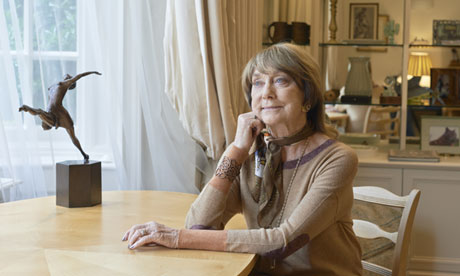
The headline of the article is “Choreographer Gillian Lynne says 'Reality TV is harming the theatre”
The article is from а newspaper under the nameplate the Guardian.
The publication date of the article is March, 24.
The article is written by Vanessa Thorpe.
The article is devoted to Gilian’s view about the fact that culture of instant fame is bad for stage shows.
The main idea of the article is to show the reader the attitude of Gillian Lynne to the TV.
The author tells the reader about Gillians’s life, her career in balet and how it is important for her. Later the author describes Gillian’s fear about the disappearing of her favourite art such as the musical theatre and it could be changed by Reality TV, that’s now everywhere. The author concludes that Gillian Lynne continues to deal with the theatre and she is glad of having such profession.
I found this article very interesting and exciting as I was under the impression of knowing that this woman, at her 87 years old, remains faithful to her business and she tries to fight against our main mind destructor like TV, the Internet and so on. I think we must follow such people’s examples.

Rendering 4


The headline of the article is “South African photographer wins award for portraits of black lesbians”.
The article is from а newspaper under the nameplate the Guardian.
The publication date of the article is March, 21.
The article is written by Mark Brown, arts correspondent.
The article is devoted to Zanele Muholi’awards for her courage and the powerful statements made by her work. The purpose of the author is to give the reader some information on the fact that it doesn’t matter at all what you are painting, for us it’s important to understand the feelings of the painter and read his thoughts.
The author starts by telling the reader that South African photographer Zanele Muholi has spent the last 10 years determinedly creating a visual archive of black lesbian life in South Africa, often in the face of considerable opposition. Then the author describes the mood of people when they have known about Zanele’s award. According to the words of Zalene, it's necessary to mention about the fact that  South Africa was country of huge contrasts for gay people: on the one hand it has been enormously progressive and in 1996 became the first country in the world to constitutionally prohibit discrimination on the grounds of sexual orientation; on the other, there is a culture of fear if you are gay and serious hate crime is a huge problem, including "corrective" rape to "straighten out" lesbians. In the last year, four women have been murdered because of their sexuality, including Phumeza Nkolonzi, 22, who was shot dead in front of her grandmother and niece, and Sihle Sikoji, aged 19 when she was stabbed to death. So, in conclusion, Zanele has shown tremendous bravery in the face of criticism and harassment for ground-breaking images which include intimate portraits of gay women in South Africa, where homosexuality is still taboo and lesbians are the target of horrific hate crimes. She has won the award both for her courage and the powerful statements made by her work.
I found this article interesting and exiting at the same time as personally, I am against gay men and gay women, and especially, I’m against to show these relations in the art, cinema and so on and so forth. To my mind, it destroys our minds, our children’s minds and can lead to something awful! I can’t say anything more about this.

воскресенье, 3 марта 2013 г.

Film Review


The movie details the experiences of "Peter Pan" author J.M. Barrie, which lead him to write the children's classic. He got to know four children who have no father. Drawing from his time with the kids, he writes a story about children who don't want to grow up.The film was directed by Marc Forster. he screenplay by David Magee is based on the play The Man Who Was Peter Pan by Allan Knee. The film was nominated for several Oscars, including Best Picture, Best Adapted Screenplay and Best Actor for Depp's portrayal of J. M. Barrie, and won one for Jan A. P. Kaczmarek's musical score.
Finding Neverland is one of the best films I have seen all year. Depp and Winslet are superb and their supporting cast is very strong in particular Julie Christie, Dustin Hoffman and Freddie Highmore. Forster's direction is tight and he maintains a story which had the potential to drag. Depp delivers a performance that is truly believable and he interacts with his co-stars well, in particular, Freddie Highmore who delivers a performance that outshines Depp's. It is a tour de force of acting talent. Clearly Highmore has a great career ahead of him. 9/10 for a superb piece of film-making, made diligently but, unfortunately, up against such strong contention, it had to make do with a disappointing award haul.

Rendering 3


The headline of the article is Rediscovered portrait of early feminist goes under the hammer. 
The article is from а newspaper under the nameplate The Guardian. 
The article is dated the 3d March 2013. T
he author of the article is Vanessa Thrope. 
The article touches upon the topic of picture and its sale. 
The aim of the article is to provide the reader with some information about the portrait of  Lady Anne Clifford which is now to go under the hammer at the prestigious annual fine art fair in Maastricht, where it is expected to sell for around £350,000. 
The author starts by telling the reader about the foundation of this picture. According to the text the rediscovery of this strong and telling portrait, previously thought lost, is a significant addition to the small extant oeuvre of William Larkin and likewise to the iconography of Lady Anne Clifford, who is today revered by feminists as an early exponent of women's rights. The author comes to the conclusion that this piicture must be at its owners.
I found the article very interesting and important as it teaches us not to forget about our ancestors and their life and work.  We must keep their things in touch in spite of offering some worth things.